Monday, March 25, 2024

大日本スリ集団 / Dai Nippon suri shūdan / The Great Japanese Pick-pocket Club (1969)

Release date: November 22, 1969
Director: Jun Fukuda
Studio: Toho
Cast: Keiju Kobayashi, Norihei Miki, Wakako Sakai, Noriko Takahashi, Minori Terada, Kunie Tanaka, Daigo Kusano, Hideo Sunazuka, Akihiko Hirata et al
Availability: Streaming and available on DVD from amazon.co.jp.
____

Jun Fukuda is a director who really does not get enough appreciation outside of his Godzilla films (which he was notoriously hard on himself about). I was looking forward to watching this one because the cast is pretty much entirely actors who I'm a fan of - in fact, I had copy/pasted a list of cast members that I found online into this post, but once I actually started watching the movie, I had to amend the list, because it turns out there were even more actors I'm a fan of in it than what I read online.

Also, in the time between when I got this DVD in the mail this morning and when I'm writing now, late at night, I found out Minori Terada had died. So this one goes out to him. Seeing him in Ultraman Blazar was really unexpected and it was a damn good final role. RIP. Everybody go watch The Human Bullet.

No subs for this one. I shall use all of my brainpower to attempt to grok the plot.


Funakoshi (Kobayashi) and Hiradaira (Miki) are old pals who served in the army together, but one of them is now a pickpocket and the other is a detective who hates pickpockets. Hiradaira calls Funakoshi "danna" (sort of a "my lord"/"sir"-type form of address) and Funakoshi calls Hiradaira "Hira-yan" ("-yan" is, from what I understand, a familiar/informal suffix), which tells you a lot about the dynamic between the two.

Hiradaira has a pickpocketing ring that employs many goons, two of which are played by Hideo Sunazuka and Akihiko Hirata. Hirata's character is called "France" for reasons I cannot determine. The pickpocketing ring also has newer members, lower in hierarchy, who are subjected to harsh training, like dipping their fingers into boiling water to condition them into having faster reflexes. 

pictured: goons

Funakoshi, meanwhile, is working out a plan with his fellow cops to take down the pickpocketing group. We learn through a brief flashback that his grudge against pickpockets stems from childhood. Funakoshi also has a daughter, Akiko (Wakako Sakai), who seems friendly with Kunie Tanaka's character (a coworker of Funakoshi). Hiradaira has three children as well: two under 10 and an older son from a previous marriage named Heiichiro, who is played by Minori Terada.
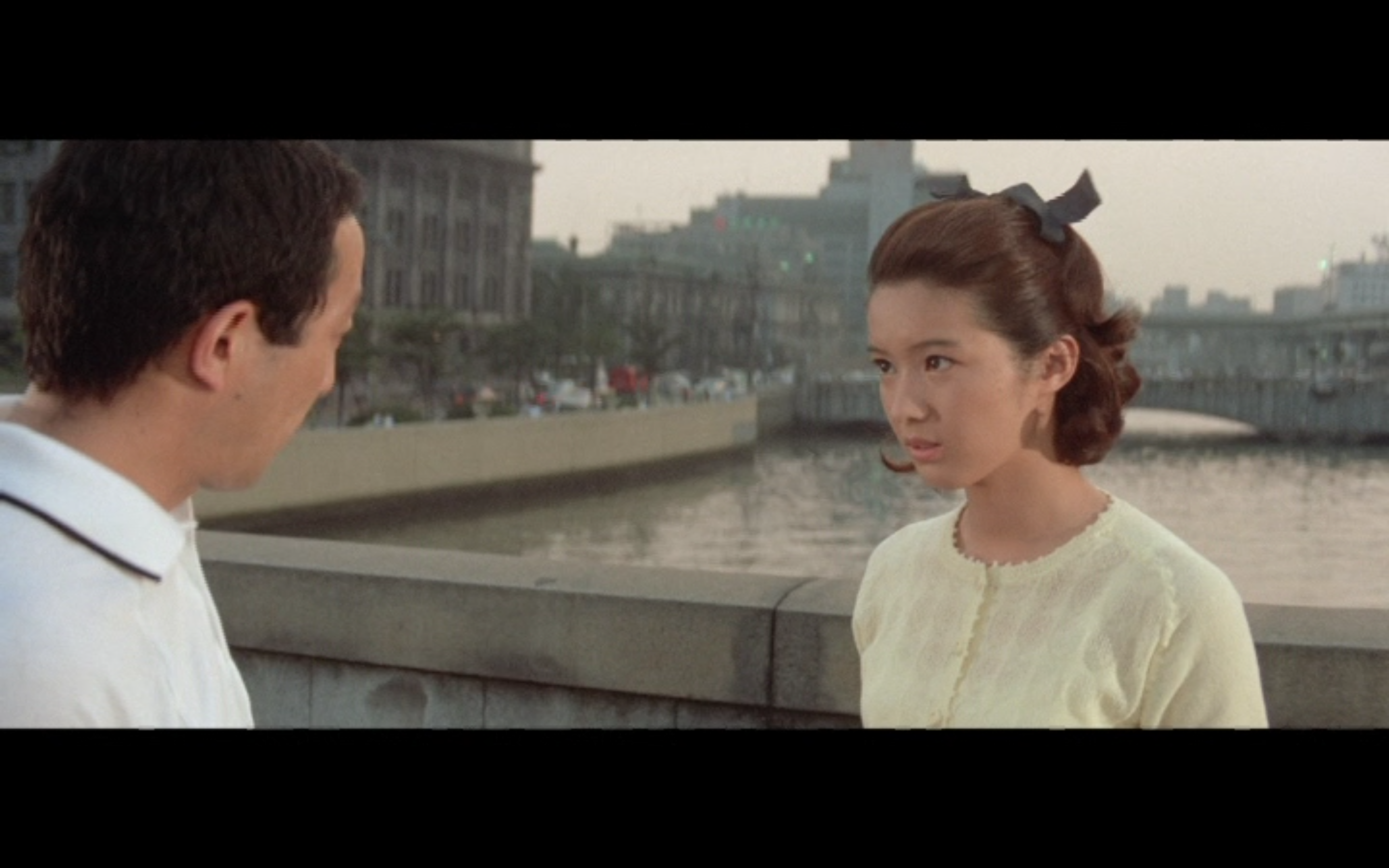

google translate is incredibly insistent on calling him "agriculture terada"

Hiradaira's group doesn't exactly operate in the dark; France and his other fellow pickpockets hang out at his house with his wife (played by a very beautiful Noriko Takahashi), who is also in on it, and entertain Funakoshi during a get-together for war veterans. France does card tricks (and steals wallets) and Hiradaira's wife does a burlesque-type dance; very Fukuda.


actually kind of a proto-mr. k outfit going on here

At the get-together, Funakoshi asks Hiradaira to pickpocket something from Akiko as he's concerned about her. Hiradaira steals a letter out of her purse that turns out to be a marriage certificate. Akiko is involved with a man named Shiroyama who has a wife and children. I'm not clear on context - is she attempting to marry him? Attempting to break up his marriage? Funakoshi doesn't approach his daughter about this directly, which in my opinion is his first and biggest mistake. 

Funakoshi eventually tails France into a pachinko parlor and actually manages to cuff him, but he escapes. After a genuinely exciting pursuit France ends up accidentally hit by a car. Hiradaira is now down his best goon, but up one motive for revenge.

(Even France's wife never refers to him as anything but "France", which is... strange. Imagine an arty, highbrow American mafia movie where the widow of a mafioso continues referring to her dead husband as "Frenchy" even during dramatic moments. That's how this feels.)


Anyway, Hiradaira exacts revenge by telling Akiko about how her father asked him to steal the marriage papers. Akiko runs away from home because of this - we don't see it directly, but Funakoshi confronts Hiradaira with a letter Akiko wrote to say she was leaving. The two of them hash it out physically, Funakoshi angry about his daughter and Hiradaira angry about France's death. I really like the awkward length of their fight scene, and the way it's capped off with a shot of Akiko's letters drifting off in the breeze, as if to say the reason for the fight was unimportant and that at that point they were just fighting for fighting's sake.


Funakoshi ramps up the crackdown on his former friend's pickpocketing ring, and Hiradaira ramps up his pickpocketing operations, enlisting a pool of underlings to steal wallets during a parade and making off with loads of cash. Both Akiko and Heiichiro return home, but Akiko tells Funakoshi that she's not there to stay. She leaves, and writes Funakoshi another letter saying that she's going to Brazil. Funakoshi, meanwhile, has retaliated against Hiradaira by calling the boss of his son's gang and telling him Heiichiro has betrayed them. As per yakuza rule, this means Heiichiro has to cut off one of his fingers.

The film basically ends when Hiradaira storms Funakoshi's office and is in such a state of rage over his son's fate that he has a stroke. It's an abrupt ending that sounds comical on paper, but - like most things in this movie - really just doesn't register as funny. Funakoshi later catches Hiradaira on the street trying to steal somebody's wallet even in his enfeebled condition, and Hiradaira begs him to arrest him, but Funakoshi agrees to place him in a nursing home instead.

hey Tora-san fans, look who it is!

Odd movie! Odd vibes! Going in, I expected one of Jun Fukuda's typical outlandish comedies, and while the vibrant cinematography and '60s culture was still present, the humor was not. To me, the storyline just felt mean: these two men are in such a deep feud with each other that it spills over into their personal lives, and they both essentially ruin each other's families. There's also a weird undercurrent of overly controlling fatherhood here - like, "oh, yeah, you told my daughter I was sneaking around and eavesdropping on her private life, but you're the one at fault for telling her, not me for doing it." As I understand it, this was adapted from a novel and co-directed by Jo Aizawa, which may account for the watering-down of Fukuda's usual directorial style. It is good, but not what I expected, and also difficult to understand the nuances of if you're not following the dialogue 100%, which I wasn't.

So if you're watching this one I'd highly recommend not going in expecting a comedy and instead readying yourself for a complicated drama about two people who used to be friends tearing each other's lives apart. It's not bleak or anything, but there's really no humor at all. Hirata looks sharp as hell, though, and does card tricks, so, you know, worth admission.

Saturday, March 23, 2024

キネマ旬報 1979年10月下旬号 / Kinema Junpo, Late October 1979 Issue

I won this on Yahoo! Auctions, although I don't think "won" is the right word to use, considering that literally no one but me bid on it. 

Anyway, if kinenote.com is to be believed, this is the only article Kinejun has run that is entirely about Akihiko Hirata, not just a movie he was in. The occasion appears to have been a re-release of many major Godzilla films and other Toho tokusatsu works that year (which was the 25th anniversary of the first Godzilla film.) I'm not sure if this has ever been uploaded online, either as scans or just the text, so I'm including both the original in Japanese and a machine translation which I have typed up and made more readable by fixing pronouns, sentence structure, etc.; the kind of stuff that gets garbled in machine translations. I've been over it a couple of times, and it's still not very good, but it's something. The photographer is credited as Koji Nishikawa, who I'm assuming also did the interviewing and wrote the article.

Visualize me cringing while trying very hard not to break the spine by putting this in my scanner...


_____________

The film opens. The familiar music by Akira Ifukube begins to play. The Toho logo appears. The names of the staff, including producer Tomoyuki Tanaka and special effects director Eiji Tsuburaya, are listed. The names of the actors follow, and finally director Ishirō Honda appears. All the while, loud applause rings out intermittently throughout the theater. This is the scene at the Nichigeki Theater, where Toho's best special effects films were shown all at once, under the title "Godzilla Movie Collection [All August]". 

The last screening, which featured older films, was particularly lively. The audience was a diverse bunch, from elementary and middle school students to the kind of old men you might see at a film center, to young housewives with small children. They all gave generous applause to the screen. They clapped when the spaceship came out, and clapped again when the robot appeared. The children joined in, clapping. They seemed at first to be clapping without knowing what was going on, but they did know what was going on, shouting things like "Moguera will show up soon!" Kids these days study even old films as well.

I myself was moved to tears by the aerial combat scene in Battle in Outer Space, which I saw again for the first time in a long time. The excitement of seeing rocket fighter planes modeled after the experimental X155 aircraft of the time take off from the pages of boys' manga and fantasy drawings and engage in actual battles in out space on the screen is indescribable. Moreover, this is merely a dream imagined by the Japanese, which is why it is far more exciting than something like Star Wars. I could go on and on about this, so I'll stop here.

The actor who received the most applause at the "Godzilla Movie Collection" at the Nichigeki was Akihiko Hirata.

 - "That's what I heard. I got a letter from a fan saying 'Hirata was a [great actor]'. I was puzzled, thinking that was a strange thing to do. [laughs]"

Hirata appeared in 7 of the 15 Godzilla films alone. Including other works, he has appeared in about 30 Toho special effects films. [I asked] "Have you seen the overseas version of Godzilla?"

- "Yes, I have. I was surprised to hear that I speak good English [laughs]. During the peak of Godzilla movies, I received a lot of fan mail from America and Southeast Asia."

Recently, he says he has been receiving fan mail and doujinshi from all over the country. There are also countless magazines featuring Godzilla movies on racks. When I showed one to Hirata, he said, "Oh, that brings back memories, a [...]1monster movie... the black-and-white, documentary-like feel is very powerful. I think the first Godzilla is the best. Godzilla's personality and appearance changed after it was in color." 

"When we were filming, we didn't know what we were doing, but now it feels like a classic. The filmmakers didn't know what they were doing, so they probably had three newcomers to it. The special effects scenes were done after the main story was almost finished, so it was even more confusing for us. Godzilla appeared, but when they told me to look at him, I didn't know where to look [laughs]." 

"The thing I found difficult was the stop-motion animation of the [models]. [They] shot the Godzilla [model] by moving it little by little. The doll was about 1 meter (3 feet) tall".

I had never heard that stop-motion animation2 was used in Godzilla. [I ask] if a new Godzilla movie were made, would you like to appear in it again?

 - "I'd like to appear in it again. But I'd like to see one that isn't made for children."

Hirata has played many roles as genius scientists, staring with Dr. Serizawa in Godzilla. In the latest film in the series, [his character, Shinzo Mafune] even won a Nobel Prize.

  - "I'm actually not good at science," he says with a wry smile.

In war movies, he plays an officer. In Ebirah, Horror of the Deep, he wears an eyepatch like Dr. Serizawa and plays a one-eyed soldier. This kind of thing really suits him.

  - "There are a lot of them, aren't there? Is that right? I wonder. I still remember something that Yoshikata Yoda told me before. He said 'there are no actors who can play ordinary people'. I thought I could do anything, but I ended up playing a lot of serious roles."

That's because, when you hear Hirata's background, he's quite far from an ordinary person. Born in Gyeongseong, Korea3 in 1927, he returned to Japan before he even knew it. He received a strict, Spartan education and entered the Tokyo Army Cadet School.

  - "I had no intention of becoming a soldier at all. When I was a child, I admired Beethoven4, and I wanted to be a composer. When I was in elementary school, I wanted to go to Tokyo University and become a businessman. My older brother tried to get into military school and failed both times. Yes, it's difficult after all. Then, a distant relative was an army general, so someone had to become a soldier, and I was chosen. I applied, reluctantly, and I got in..."

His older brother is Yoshiki Onoda, a director currently active in TV after working for Shintoho. After graduating from military school, Hirata went on to the Army Academy just before the end of the war. There was a plan to move the Imperial Headquarters into the mountains of Nagano in preparation for the mainland battle, and he was training at the foot of Mt. Asama as a guard [as] he was an elite soldier.5 [I ask] "So, when the war ended..."

 - "Well, that was a blank period. Of course, I thought I would die before the war ended."

He returned home in a daze. After graduating from First High School and the law department of the University of Tokyo, he joined [Tokyo Boeki] (later Mitsubishi). He said that he never wanted to serve a government official again, so he joined a private company.

 - "I was pure-bred in the military, isolated from the outside world, and was only taught to die for the country and the emperor, so I didn't know anything. It's a strange story, but I didn't know anything about sex. I guess this goes on tape... I didn't even know what a wet dream was[...]6"

In reaction to that lifestyle, after entering the University of Tokyo, he didn't study much, but instead devoted himself to theater and dance. He made his debut at the May Festival, and was called a hammy actor.7 At first, he was quite calm, thinking that this was just how it was. His house was used as a dormitory for Shintoho staff and actors, so he started to associate with people in the film industry, and while he was a student, he worked part-time as an assistant director. His first film was Lynching, directed by Nobuo Nakagawa, in which Yoshiko Kuga appeared alongside Ryō Ikebe. Kuga is now Hirata's wife.

 - "She's short, so when she talked to Ryō, I put her on a platform. I had to hold the platform as hard as I could, it's so ridiculous [laughs]. I remember that, but she doesn't remember it at all."

[I ask him] how they met.

 - "We worked together on Hiroshi Inagaki's Siege of Osaka Castle. We went to Gotemba for filming, and the weather was so bad it was extended by about 10 days. During that time, we played mahjongg to kill time, and we became friends, and that was it."

Hirata is a former army alumnus from Tokyo University. Kuga is the daughter of a former duke. It's a dramatic setting that reminds me of Gone With the Wind, in which Hirata played Ashley...

 - "That's not true. He was a poor duke, and since the aristocracy was abolished, his title is worthless. When we're at home, we're always wearing rags. I say "you should behave a little better, you're being disrespectful to your husband." When people come over, we get in trouble and panic. We're like a beggar couple [laughs]."

When they're at home, they just sit around doing nothing. Hirata is reading a book in silence. His wife is talking to herself. "I see, I see," Hirata nods nonchalantly.

They're happy. Their wedding anniversary is - "October 9, 1961," she answers immediately. They go outside to take a photo. Hirata's figure, with his back straight and his slow strides, would look like a scene from a movie if he were in a military uniform.

 - "I can't get rid of old habits..."

___

1 The word here translates literally to "waterfall", so I'm assuming it's being used metaphorically, but I'm not sure what it means in this context.

2 In the original text this is referred to in kana as "dynamation".

3 Known as Keijo at the time, this is now in Seoul.

4 Same birthday.

5 I mean, he wasn't quite 18 when the war ended, but okay.

6 I'm not gonna be the one to translate the rest of this sentence for the first time ever. It's not weird or anything, but... yeah, no.

7 The original word used here was "daikon", like the radish, which is kind of a colloquial term to refer to a ham actor.

Thursday, March 21, 2024

ぴったしカンカン / Pittashi Kan-Kan / Perfect Kan-Kan episode #245 (1980)

"Perfect Kan-Kan" is one of those television shows where, when I research it, I find scores of people saying things like "I remember watching this! I loved this show!", but few, if any, actual full episodes are preserved. Such is the case for Akihiko Hirata's tenure on the show, which as far as I can tell would be in the dustbin of history if it were not for Hibari Misora.

Starting in 1975, Hirata appeared as a regular on this game show, the specifics of which are obtuse and not helped any by machine translation. From what I understand, the concept is that a team of four "regular people" are pitted against a team of celebrities (hosted by Konto 55's Jiro Sakagami for a while) to answer trivia questions in front of a live audience. There's a couple of episodes on YouTube (mostly from the late '80s), but none with Hirata on the team - except for one. This survives only because Hibari Misora personally owned a VHS recording of it. The studio lost the master tape, so they had to use her copy for a re-broadcast in 2009.

Here's the whole damn thing. I'd embed the video, but the uploader disabled embedding.


Now, I do understand a little Japanese, but Japanese game shows are on another level. I was missing 90% of this. Misora is, obviously, a guest, and most if not all of the trivia questions appear to be about her. The two I understood seemed to be something like "what did she get for a present" (Hirata answers "a letter" and then "a kiss"[!], the correct answer was "a ring") and one about her favorite food (I believe Hirata guesses sashimi, but the correct answer was ochazuke [green tea over rice]). 

I wasn't happy with not knowing what everyone says before they introduce themselves, so I tried to translate YouTube's auto-generated Japanese subtitles into English, and it's probably a dumpster fire, but take it anyway, I spent an hour of my life on it:

Jiro Sakagami: "People often say 'Jiro-san is really dark-skinned, it must be that he gets tanned while in the sea', but really I got tanned while weeding. After all, I have a 20,000 tsubo garden." [This would be approximately 66,000 square meters, or 710,418 square feet]
Akihiko Hirata: [The subtitles absolutely hate this part but I think it's something to the effect of not having time to tan because he has to read 20,000 books this summer]
Maria Asahina: "Jiro-san told me 'Maria, you've lost weight'. Of course, I lost 20,000 kilo this summer."
Shunji Fujimura: "People say that Fujimura has a strange look on his face, and that's no wonder, I was born 20,000 years ago."

Everybody is making some kind of pun around the word "ni man" (20,000) that I can't even begin to decipher. The auto-generated subs also kept thinking people were saying "nasu" [eggplant] instead of "natsu" [summer] which was causing some trouble.

The only other pictorial evidence I found of any of Hirata's appearances on the show was a Japanese Soundcloud rapper who used a still from an episode as cover art. Writing for this blog really leads me to some strange places sometimes. (The track is, admittedly, fire.)


This episode was the first time I'd ever seen him not playing a character. Of course there are interviews with him in text form that are not difficult to find, but I don't think there's exactly a huge corpus of out-of-character appearances on video out there, so this was pretty cool. Thanks, Hibari Misora, and whoever else was holding onto that tape for 29 years.

Tuesday, March 12, 2024

The 2nd Annual Japanese Academy Awards / 第2回 日本アカデミー賞特集 (1979)

The Academy Awards were held recently, both here in the US and in Japan, and in the US it's been a notable one, since Godzilla Minus One became the first Godzilla movie to win an Oscar. So as long as we're all currently thinking about the Academy Awards... can you guess who co-hosted the second ceremony?

The 2nd Japan Academy Awards were presented at the Keio Plaza Hotel in Tokyo on April 7, 1979, and co-hosted by Akira Takarada and Akihiko Hirata. All extant photos (as far as I know) from the ceremony can be viewed here. Somehow, incredibly frustratingly, Hirata did not end up in ANY pictures, but there's no shortage of Takarada.

telling my kids this was elvis.

The winners are as follows:

Best picture: Incident
Best director: Yoshitaro Nomura, for Incident
Best screenplay: Kaneto Shindo, for Incident
Best actor award: Ken Ogata
Best actress: Shinobu Otake
Best supporting actor: Tsunehiko Watase
Best supporting actress: Shinobu Otake
Best music: Toru Takemitsu
Best technology: Takashi Kawamata, for Incident
Best foreign film: Portrait of the Family

It was an Incident sweep that year, to say the very least. Best music and foreign film are the only categories in which Incident or someone related to it didn't win. 


I'm not already full of random trivia enough, so: Station is the only film Hirata had a role in that won a Japan Academy Award, in 1982 (not sure if he was in attendance for that or not), but Nomugi Pass was also nominated in 1980.

Thursday, February 29, 2024

鉄腕涙あり / Tetsuwan namida ari / Even the Mighty Shed Tears (1953)

Release date: October 27, 1953
Director: Hidesuke Takizawa
Studio: Toho/Takarazuka
Cast: Akihiko Hirata, Kahoru Uji, Sachio Sakai, Kyosuke Segawa, Shirayuki Shikibu et al.
Availability: No known home media release. No known recent screenings. The entire film is on DailyMotion in two parts, here (part 1) and here (part 2). Good quality print but the aspect ratio is stretched, I recommend sticking it into VLC and fixing it. Or you can install Stretch Video, my favorite browser extension developed by a professor of philosophy.
____

This has been one of my most sought-after films for a long time, and it somehow eluded me that it had been up there on DailyMotion for anyone to clap eyes on for the past several years.

Some factual background: this film was based on a 1952 novel by Bunjiro Asakura called Chōsen oni and featured heavy involvement from Takarazuka Revue, an all-female theater troupe founded in 1913 and still very much going strong. Kahoru Uji was a member of the troupe, and the score was provided by the music club arm of the institution. 

Here's a poster stolen off AucFan. The jpeg, I mean, I didn't actually steal the poster.


Obviously this thing is very, very not subtitled. I'm relying on online summaries and my own poor Japanese skills to figure out the plot. I encourage you to go watch this for yourself if you're interested.

The reason why I was so interested in seeing this over anything else is that this is, as far as I'm aware, literally the only time in Hirata's entire 30ish-year career where he plays the protagonist. Not the sidekick, not the important tertiary role, not the scientist or the villain or the villain's boss or something. The main character. Even before I watched this I could never understand why he didn't get any lead roles, and after having seen it I understand even less: he's fantastic in this. His character experiences visible growth throughout the arc of his story and Hirata conveys the ups and downs of Ryusaku's life whole-heartedly.

So let's move on to the actual film.


The storyline is fairly predictable and easy to follow. Hirata plays Ryusaku, a college student. Him and his girlfriend, Natsuko, are jumped by a bunch of gangsters while coming home from a movie, and they knock Ryusaku nearly unconscious and take Natsuko offscreen. Afterward, Ryusaku has a conversation with a friend in which the possibility of involving the police is brought up but dismissed (again, I do not understand much Japanese, I'm winging this super hard). Ryusaku instead resolves to get really good at karate in the hopes that nothing like the incident with the gang would ever happen again.

This is "Akihiko Hirata Does Karate: The Movie". That's it. That's the film.


He also gets a part-time job doing... uh, whatever this is:

Some kind of disinfectant service, I guess? Something something covid.

He partners up with Sachio Sakai's character, going door-to-door doing... that. On his rounds he runs into Natsuko, who doesn't want anything to do with him, and has left to start a new relationship and become a singer in a nightclub. We then get one of those scenes that are in every Toho movie of a girl singing in a swanky '50s club. Later, Ryusaku visits Natsuko at the nightclub to try to reconcile. This doesn't work out and he ends up slapping her (Ah, the '50s. Also he gets slapped later too, so, you know, equality.), she asks him to leave, and he gets into a scuffle with the guys who work at the bar, but of course this time around he knows karate.


The resulting brawl obviously gets him in some trouble both at his dojo and his part-time job. In the meantime, one of his fellow students, Sachiko, meets up with him and tries to talk to him but (from what I understood) he makes up some excuse, says he doesn't want to see her and literally sprints off in the opposite direction. He then gets fabulously drunk, gets into yet another fight with some street toughs, and ends up spooking them all into running away.

There's another woman here who I'm not sure how to fit into the picture; her and Ryusaku had previously joked about him being her "bodyguard" and while he's still drunk he stumbles back to her place. She actually tries to put the moves on him, but he doesn't appear to be into it and leaves after giving her a bundle of money(?).

Girl, me too.

Eventually Ryusaku's friends get him into a karate tournament between his university's dojo and a rival to try to raise his spirits; he seemingly wins this tournament. Afterward, he gets a letter from Katsuko telling him to meet her at a shipyard, but when he gets there, some other guy shows up instead. He asks where she is, and I didn't catch everything the other guy says, but he tells Ryusaku that the letter was a fake. Several other goons step out from the shadows. In a repeat of the beginning of the film, they all mob him... but remember, he's super good at karate now. Katsuko does eventually show up, but one of the thugs shoots her. At the last possible moment, she gets off a shot too, and kills the head of the gang before dying in Ryusaku's arms. The film ends on a high note, though, with everybody back at college and Sachiko and Ryusaku seemingly getting together for good.


WOW. So in addition to being one of the rarest titles in Hirata's filmography, Tetsuwan Namida Ari is actually really good. I'm sure I'm missing a lot due to the language barrier, but to me the film is excellent at conveying the story of a person who experiences something traumatic and makes a decision about how to respond to it that ultimately leads down a difficult path. When Ryusaku decides to pursue karate out of a desire for revenge, it doesn't lead to him gaining the ability to protect the people he cares about, but just gets him into trouble instead. It's only once he gets a handle on his own feelings of desperation and regret that he can use karate for good.

And I gotta say it's really funny to see Akihiko Hirata doing karate. I don't know anything about karate, so I have NO idea if Hirata's actually good at it or even good at faking being good at it. I did notice that, while he does some mirror sparring and brick-breaking and a couple of judo shoulder-flips, during the tournament scene at the end, you don't see him fighting his opponent; the camera keeps cutting to frontal shots of him instead of showing him actually doing anything to the other guy. But again, I can't really judge his karate skills, this is an area I have no expertise in whatsoever outside of watching a lot of Sonny Chiba movies.

I apologize heartily, because this post is long enough already, but if you're still with me, there's one last mystery here. This is going to be bothering me now. While watching this I remembered something from Hirata's IMDb page:


He absolutely does not have an eyepatch at any time in this movie. He's got kind of a bandage around his head after he gets beat up by the gang at the beginning, but it doesn't cover either of his eyes. I'm pretty sure I've heard this "fact" echoed at least a couple other times, and I am now in a position to say with 100% confidence that it's wrong. (I'm very fun at parties.) Meaning either somebody totally made it up, or there's another movie floating around where he wears an eyepatch (besides the obvious ones, I mean). Considering that that quote also mentions Tetsuwan namida ari as his "first" film role - which it is not, The Last Embrace is - I'm thinking it's possible that whoever wrote it got mixed up with The Last Embrace. But unfortunately, if that's the case, I'll never know; The Last Embrace seems all but lost.

Anyway that's it from me today. See you next time. I hope at least one person reads this and finds it interesting.

Wednesday, February 28, 2024

人喰海女 / Hitokui Ama / Man-eating Ama (1958)

Release date: July 27, 1958
Director: Yoshiki Onoda
Studio: Shintoho
Cast: Ken Utsui, Yōko Mihara, Utako Mitsuya, Masayo Banri¹, Kyôko Yashiro, Namiji Namiura, Akihiko Hirata, Tetsurō Tamba et al
Availability: No online streaming, no known recent screenings. At least one television broadcast, possibly in 2017-18. A DVD can be purchased on amazon.co.jp if it is not out of stock. (If it is out of stock, you might try getting in touch with the folks at Shintoho Cinema Nostalgia, who put out the DVD.)
____

I had plans to write about this film at some point, but I didn't think I would be writing about it after having actually seen it. I assumed that, with no physical media release, I had no chance. Even its Wikipedia page says “the film has never been released on home video, but is not lost as some sources claim.²" But then I found out that it did get a physical release - in the form of (almost) the entire movie included as a bonus feature on a DVD of another ama film. I say "almost" the entire movie because apparently the DVD release contains only 71 out of the film's total runtime of 74 minutes. I of course bought a copy immediately. I'm not sure if the missing footage was the reason why this wasn't given its own solo release or if it was something else, but I wouldn't imagine I'm the only person who would pay good money for a DVD with just Hitokui Ama alone.

Believe me when I say this is the most excited I've been about a movie in a very, very long time.

I've done as much research into this film as I could, but I still don't know anything about its production history, which is something I'm really curious about. If anybody has issues of Kinema Jumpo from August or October of 1958, hit me up, they might contain more information about this. It also had some kind of theatrical release in Belgium, which is... very weird.


This film is notable because Akihiko Hirata managed to be in it at a time when he was still under contract with Toho. A promotional flyer for the film mentions that Hirata appeared in this film specifically to celebrate his brother's debut as solo director (he had worked as assistant director for a long time beforehand), which is very nice. (Onoda's first solo debut was actually a different film released a few months before this one, but still.)

Unlike some of the other DVDs I've obtained, this one did not have subtitles of any kind, so I'm relying entirely on my own garbage Japanese skills and online plot summaries.³

Let's gooooooo.


We start the film off with a catfight between two women on the beach, because Shintoho. The fight is stopped in its tracks when one of the women notices a dead body washing onto the shore. There's a short scene at a police station afterwards, and it's revealed that the decedent had a vial of some kind of drug in his pocket. The cops rule it a suicide, but a single detective, Maruyama, believes otherwise.

Hirata's in this movie so briefly it's like he's trying to get out of there before Toho realizes he's gone.

The two main leads in the film are women divers named Sada and Kazue. They might be biological sisters; I can't really tell for sure, you know how it is. Sada had a checkered past in Tokyo that she lied about when she came back to become a diver, and while she wasn't directly responsible for the murder, she did hire an old boyfriend, Yoshizaki, to do it for her. Yoshizaki promised he'd leave after the murder, but he becomes an alcoholic and starts following Sada around, threatening her secret. Sada's new boyfriend Goro (played by Starman himself, Ken Utsui) doesn't know anything about her past, and he wants her to stop diving out of fear for her safety after the murder. We also get a fight scene between Yoshizaki and Goro that perfectly mirrors the catfight from the beginning, which I thought was interesting. This does have nice cinematography.

There's some fun underwater filming here that's surprisingly good for its time, if a bit stiff and the picture a bit cloudy. Also, Tetsurō Tamba is here. He plays a character named Miyata, who wants Goro's fishing grounds. He initially doesn't know about Sada, but Yoshizaki eventually tells him, and he becomes another party who is manipulating Sada by using her secret as leverage.


We get yet another addition to the cast when Kazue saves a man named Kimizuka, a visiting reporter from Tokyo, from cliff-diving in a dangerous spot. He and Maruyama go to a bar in Tokyo to question the proprietress about the dead man's identity.

Kazue is played by Utako Mitsuya, Yoshiki Onoda's future wife. She would later say she fell in love with him while filming this movie, when she didn't want to do a nude scene and he told her she could wear a swimsuit and strategically-placed towel instead.


Sada eventually ends up killing Yoshizaki out of self-defense. She stashes the body in the same rough patch of ocean Kazue stopped Kimizuka from diving into, but Kazue eventually finds it. There's a brief moment when we think Kazue is going to tell on Sada to Kimizuka... aaaand then we have a "Miss Ama" beauty pageant, because Shintoho. The pageant scene is actually surprisingly tense, with a group of women being looked over by a crowd of men and nearly atonal music building up to the moment when Sada comes out onstage, visibly distraught, not knowing who in the audience knows her secret.

Sada finally gives up and goes back to Miyata to let him do to her what he will. Goro knows about her secrets at this point, and was going to leave her to the cops and reporters, but Kazue convinces him to follow her to the island where she and Miyata are. We get another scuffle between Utsui and Tamba at the end, and there's a great moment where Tamba loses the fishing spear he'd been holding, pulls out another knife, then throws that knife away and grabs the fishing spear again, like, dude, just pick a knife. This seemed silly until it became apparent that he had to throw aside the second knife so Sada could conveniently find it and escape her ties.

Sada stabs Miyata, but dies from... something? Exhaustion? It's not very clear what actually happened to her. I was a bit disappointed by this because it felt like the narrative chose to take the easy way out by killing her instead of allowing her character any further growth.


Depending on how you look at it, this movie is either a murder mystery interrupted by a bunch of lengthy scenes of attractive people swimming, or a bunch of lengthy scenes of attractive people swimming interrupted by a murder mystery. I expected there to be, y'know, some cop stuff, the usual kind of thing you get in a murder mystery, but there's really not. And I kind of love it! It has this vibe like a darker, more grown-up version of a teenage beach movie, like something you'd sneak into with some friends who are not old enough to get into the theater legitimately. It's never super explicit, but there's definitely some stuff I can't post on here. It's not the best movie, but it's a relic of the past; I can't judge it by today's standards. This kind of thing made Shintoho money and gave people jobs, so I respect that.

As for the print, it's... certainly what you would expect from a film whose existence was uncertain for much of the last 65 years. The sound is pretty good, and it's visually crisp (i.e. not blurry or pixelated at all), but it's so dim at times that I couldn't tell if they were doing day-for-night shots or if it was the film itself. No frame is without grain and vertical lines running through it, although it's not enough to be distracting. As I said at the beginning, there's three minutes missing, and you can definitely tell that there's points where a scene cuts off prematurely or skips oddly. All in all it's a very old, very rare movie that we're extremely lucky has survived and is now (kind of) back in print.

If nothing else, I highly recommend this if you've got it bad for Tetsurō Tamba.

_____
¹ Banri, Toru Yuri and Toyoko Takechi are currently the only three people I'm aware of who worked with all three Onoda siblings.

² The source referred to here is Jasper Sharp's 2008 book Behind the Pink Curtain: The Complete History of Japanese Sex Cinema. Sharp dedicates pages 33-43 to a very astute survey of the phenomenon of ama films, and of Hitokui Ama, he says: "Shintoho would find a suitably buxom replacement for [Michiko] Maeda in the form of Yôko Mihara, first appearing in Yoshiki Onoda's intriguingly-titled Cannibal Ama in 1958, a movie which unfortunately appears to be no longer with us."

³ I'm very thankful to this person's blog post for providing me with a lot of information about the plot, as well as the knowledge that this was broadcast on television at some point in the past.


Monday, February 26, 2024

空想天国 / Kūsō Tengoku / Fantasy Paradise (1968)

Release date: August 17, 1968
Director: Takeshi "Ken" Matsumori
Studio: Toho
Cast: Kei Tani, Wakako Sakai, Akira Takarada, Yû Fujiki, Hajime Hana, Senri Sakurai, Yoshiko Toyoura, Makoto Fujita, Akemi Kita, Akihiko Hirata, Ikio Sawamura et al.
Avaiability: Streaming on Amazon Prime (Japan only). An unsubtitled DVD is also available. No known recent screenings.
____

We've got a fairly obscure one today. It's got all your usual Toho guys (and gals) in it, but for some reason you have to go to the film's Wikipedia page to find out that Hirata is in the cast at all. IMDb doesn't mention him, and neither does eiga.com or even Toho Kingdom. Not sure why this is; he's got a small role, but he's definitely there, and is credited on IMDb for roles far, far briefer than this one.

Despite its obscurity, the film had a tiny mention in issue #15 of Japanese Fantasy Film Journal in 1983, which was, I assume, its first acknowledgement in Western media. I won't spoil it this early on in the post, but that is... not the plot of the film at all.

It's extremely funny to me that this claims the English translation is "fancy paradise" because there is absolutely no way you can translate "kūsō" as "fancy", which means the only possible way this mistake could have been made is if someone verbally told the writer the translated title and they misheard "fantasy" as "fancy".

This is sort-of, kind-of a Crazy Cats movie; it's not considered part of the main continuity but it is definitely related in some sense. For those keeping score at home, that's five Crazy cats movies Hirata's been in: Musekinin Yūkyōden [It's a Bet, AKA Tale of Irresponsible Justice], Kureji no Daibakuhatsu [Crazy Big Explosion], Kurējī no Musekinin Shimizu Minato [Crazy Irresponsible Shimizu Port, AKA The Boss of Pick-Pocket Bay], Kurējī no Nagurikomi Shimizu Minato [Crazy Raid on Shimizu Port], and this one. And as long as we're talking Crazy Cats, RIP Hiroshi Inuzuka, who died about six months ago and was the last surviving member of the troupe.

One final note: "kuso" - without the stressed syllables - is basically the equivalent of "shit" (or can be used to convey that something is smelly/shitty). I cannot imagine that this was unintentional.

Anyway, let's get it going. I'm using my usual method of putting on the Japanese subtitles and pointing my phone at the screen to translate. Again, all screenshots are from my own DVD copy, but everything contained therein is copyrighted to Toho.

This movie has some very cool animated opening credits.

Toho is arguably referencing Gamera in the name ("Gamara") of the protagonist's imaginary frog friend. A lot of ink has been spilled about what an officially-sanctioned Godzilla vs. Gamera movie would be like, and that may never come to pass, but it's interesting that as early as 1968, Toho was acknowledging their biggest rival.

Kei Tani plays Keitaro Tamaru, an absent-minded office worker at an architectural firm who lives with his mother. He has an imaginary friend named Gamara, and the film opens with a dream sequence in which Keitaro and Gamara are torpedoing enemy subs until their own sub is hit and sunk. When Keitaro goes into work that day, he gets news that a school building his firm designed recently collapsed in an earthquake. He goes to Kaitō to meet with the daughter of the school's principal, who died in the collapse, and subsequently gets into a brawl with Yû Fujiki and his goons about whether the collapse was the fault of Keitaro's firm or of the builders, who cut corners during construction. This whole thing doesn't really come up again, but it's an excuse to have Fujiki in the movie, and I always like seeing him be a goofball, so I can't complain.

Akira Takarada is here too. And he plays soccer. His character is named Maeno, and he and Keitaro are constantly competing for the affections of the same women - Maeno far more effortlessly than Keitaro.


The primary "gimmick" of this movie is that Keitaro keeps lapsing into elaborate fantasy sequences where he's any number of archetypical heroes: sometimes a swordsman in a jidaigeki, sometimes a singer with a ukulele, sometimes a soldier at war, sometimes a Western-style, gun-toting badass who must defeat his opponent, "One-Eyed Jack" (Maeno) before he marries the girl Keitaro has a crush on. I was really, really hoping Takarada would show up in an eyepatch so I could make some terrible jokes, but alas, he does not.


Also, I gotta be honest here, Gamara kind of scares me.

Black eyes... like a doll's eyes.

One day, Keitaro's boss lets him know that he's bought into a new building material that's supposed to be super-strong but super-light, and is extremely valuable. Everyone wants to get their hands on it, but the plans that incorporate this new material are top-secret. Keitaro keeps mum, but pretty soon there's a robbery at the firm and some of these important plans are stolen. The thieves knock the chief of security unconscious and kidnap his daughter, Hiroko. We find out that this theft was an inside job, and the shot-caller was the firm manager's secretary, Michiko, who we'd met earlier in the film. Keitaro and Maeno both pursue, but the cops get the wrong idea about Keitaro and arrest him. Maeno is stealthier, and makes it to the apartment where Michiko and her thugs have Hiroko tied up, but ends up in the same situation as Hiroko.

Meanwhile, Keitaro breaks out of jail and a long chase/fantasy sequence ensues, but it's all in vain as the criminals catch him too and whisk the three of them - Keitaro, Maeno, and Hiroko - off to some kind of secret location on an island. Their boss is, of course, Akihiko Hirata with a highly dastardly goatee. (His character is just credited as "Boss" here, no actual name.)


The three of them eventually escape, and locate a raft, but unfortunately the raft only fits two people, so Maeno and Hiroko return to the mainland for help while Keitaro has another fantasy sequence. The cops show up, arrest all the criminals, and Keitaro still does not get the girl, because that would ruin the whole point of the film.

This movie... eh. I think I'm just not a fan of the kind of comedy where the whole joke is "isn't it funny how no one will date this guy". It's visually a treat - I didn't take many screenshots, but the entire film has beautifully vibrant, uniquely 1960s cinematography. The action is fun, and the framing device of the protagonist repeatedly having fantasy and dream sequences allows for more action than would otherwise befit a movie like this. But all things considered, I wasn't too jazzed about this one, which is a bit dismaying. I never thought I'd be at a point in my life where I could think an industrial espionage comedy musical where the main character has an imaginary friend who's a guy in a frog suit was boring. Apparently, when this came out, it was released on a double-bill with Admiral Yamamoto, which is... certainly one hell of a double-bill.

I don't think this was the best entry into the Crazy Cats canon for somebody completely unfamiliar with it, but fortunately I've found that all of the other films I mentioned at the start of this review are also available to buy on amazon.co.jp for the next time I feel like being financially irresponsible.

If you're also interested in Crazy Cats, there's a really wonderful website run by someone who gives easier-to-read (though still in Japanese, you'll have to use a translator) information than Wikipedia on all the films and more.